1
Lesson 1
The Automation Landscape
Establish the vocabulary and conceptual boundaries of Quickbase automation, distinguishing record-driven, time-driven, report-driven, and workflow-driven behavior before building anything.
Open tutorial→
Quickbase Explained
Independent Quickbase Field Study
Learn it · Build it · Investigate it
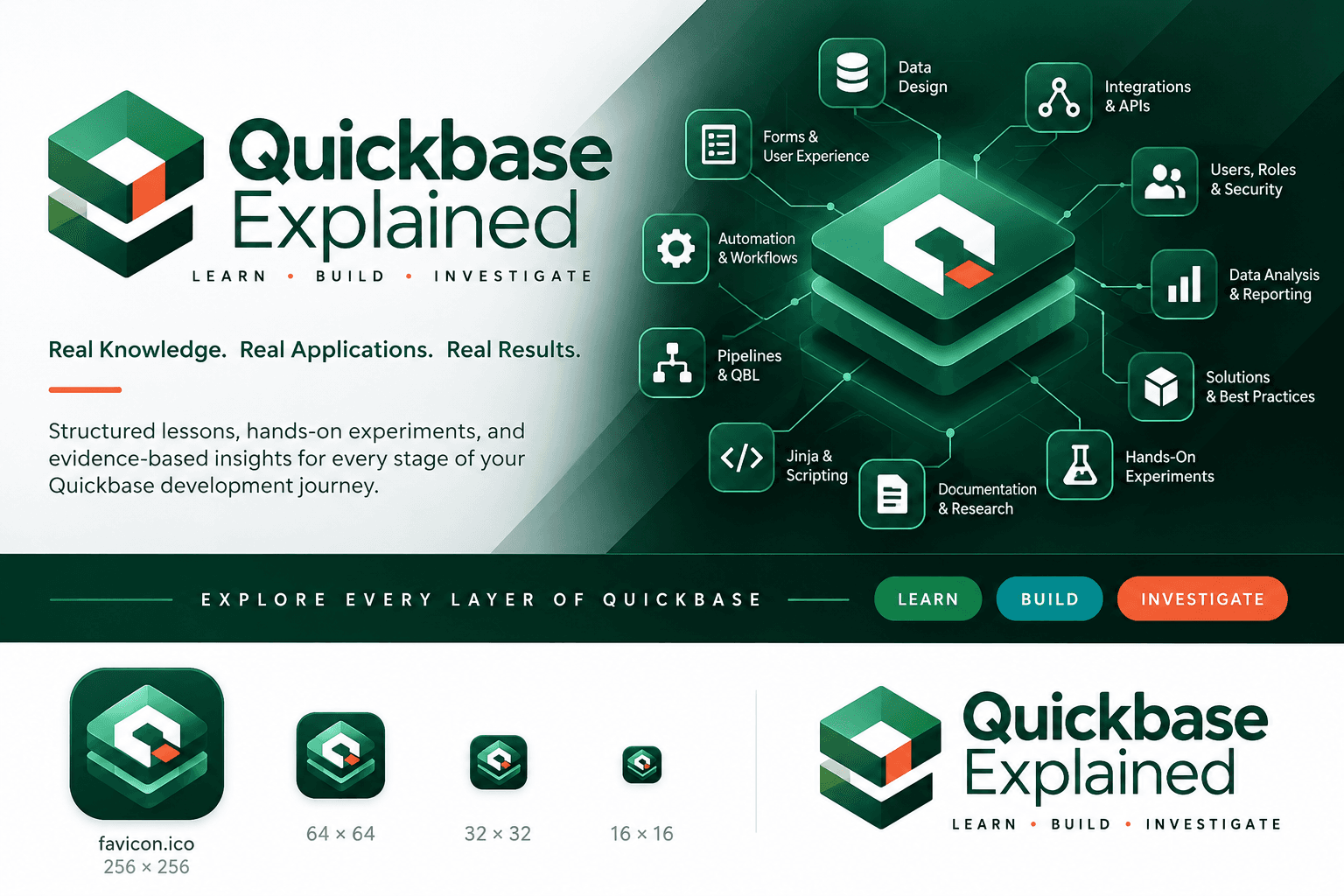
Quickbase Explained is an independent learning and research project devoted to understanding how Quickbase works across data design, forms, automation, Pipelines, integrations, APIs, security, reporting, and application architecture.
The Automation Developer Lab is the first major investigation within that larger project. It begins with native communication and record events, then follows automation into workflow design, Pipeline execution, queries, actions, runtime references, collections, conditions, loops, metadata, Jinja, and integration.
01
Predict
02
Test
03
Observe
04
Explain
Every explanation is grounded in documentation, controlled experiments, and observed behavior. When new evidence changes our understanding, the explanation changes with it.
Course Premise
Quickbase contains several mechanisms that can reasonably be called automation. They overlap in places, but they do not all respond to the same events or produce the same kinds of results.
Before choosing Notifications, Reminders, Subscriptions, Custom Emails, or Pipelines, this lab asks three more fundamental questions.
Did a record change? Did a date become important? Did a schedule execute? Did an external system cause something to happen?
Does Quickbase know only that a record changed, which field changed, its current state, its previous state, or related data?
Should someone receive information, should data change, should related records be queried, or should an entire workflow execute?
Learning Progression
Pipelines are not treated as an isolated advanced feature. The course progressively develops the concepts that eventually make a Pipeline understandable.
Automation Mental Model
Automation begins with Quickbase data, records, fields, and values.
Quickbase begins by telling people that something matters.
Something happens that gives Quickbase a reason to react.
Dates and schedules allow something to matter even when no record was manually changed.
Rules determine whether the event or situation should cause anything else to happen.
Records move from one meaningful condition to another, such as Open → Complete.
Events, conditions, information, and actions become an organized process.
Convergence Point
The earlier concepts converge into realm-level workflow orchestration. Triggers begin execution, steps retrieve and modify data, references carry runtime values forward, queries produce collections, and conditions and loops control how that work continues.
Laboratory Territory
These are broad areas of study rather than a frozen feature checklist. Some have already produced entire groups of lessons; others remain ahead of us. The curriculum continues to evolve as Quickbase behavior is tested, documented, and better understood.
Alerts, Notifications, Reminders, Subscriptions, Custom Emails, recipients, message content, and delivery behavior.
Record additions, modifications, deletions, field changes, and the distinction between an event and the state produced by it.
Record-relative dates, scheduled execution, calendar-driven behavior, and what happens when nobody edits a record.
Current values, previous values, transitions, decision criteria, and the difference between something changing and something being true.
Dynamic recipients, authorization context, user permissions, external recipients, sensitive information, and execution authority.
Report-driven communication, scheduled delivery, personalized output, and the relationship between presentation and access.
Realm-level workflow orchestration, triggers, queries, actions, Channels, Accounts, step references, runtime data, collections, conditions, loops, metadata, scope, execution evidence, and multi-step workflow.
QBL, Jinja expressions, JSON, field and record identifiers, structured values, runtime references, metadata, and the distinction between business data and execution context.
REST API requests inside larger workflows and the connection between the Automation Lab and earlier Quickbase developer work.
Activity Log evidence, step input and output, lifecycle metadata, failures, permissions, missing data, execution history, Replay, bulk behavior, debugging, and the difference between final record state and the complete execution story.
Choosing the simplest correct tool instead of automatically selecting the most powerful mechanism.
Predict behavior, run controlled tests, observe Quickbase, compare the result with expectations, and revise the model.
Laboratory Method
This is intentionally not a complete theoretical curriculum written in advance.
A topic is investigated first. Documentation is studied. Predictions are made. Quickbase is tested. Results are compared with expectations. Only then is the finished lesson written.
Step 1
Begin with something about Quickbase that we genuinely want to understand.
Step 2
Study Quickbase documentation, terminology, configuration options, and known limitations before building the experiment.
Step 3
State what we believe Quickbase should do before we run the test.
Step 4
Make a controlled change in the Automation Lab and allow Quickbase to respond.
Step 5
Record what Quickbase actually did without changing the explanation to fit our expectation.
Step 6
Compare the observed result with the original prediction and the documented behavior.
Step 7
Keep what survived the experiment, correct what did not, and refine the mental model before teaching it.
Final Step
Only after the behavior has been researched, predicted, tested, observed, and reconciled does it become a published tutorial.
Important
That includes assumptions made at the beginning of this lab. Unexpected behavior is not an inconvenience to the curriculum. It is often where the most useful lesson begins.
Evidence Matters
Findings throughout the lab are separated into documented behavior, direct observations, reasonable inferences, and speculation. A useful mental model may explain the evidence without pretending that we know undocumented details about Quickbase's internal implementation.
Developer Continuity
Automation does not replace Quickbase application development. Automation operates on top of the same tables, records, fields, relationships, permissions, identifiers, queries, and APIs.
Earlier Developer Lab
Apps, tables, records, fields, DBIDs, FIDs, relationships, QBL, JSON, JavaScript, and REST APIs.
Automation Developer Lab
Events, time, conditions, state, communication, workflow orchestration, queries, actions, runtime references, collections, loops, metadata, scope, execution evidence, and integrations.
Foundation Layer
Automation begins with the structure already present in a Quickbase application. These are the objects, data, connections, and security boundaries the automation will eventually operate against.
Apps
Application boundary
Tables
Structured collections
Records
Individual data entries
Fields
Values and attributes
Relationships
Connections between data
Permissions
Access and authority
Expression & Data Layer
These languages and formats describe what data we want, how dynamic values are expressed, and how structured information moves between systems.
QBL
Find and filter Quickbase records
Jinja
Evaluate and transform values available in Pipeline runtime context
JSON
Represent structured data
Execution Layer
These are the mechanisms that use the underlying data model and languages to communicate, automate work, or interact with Quickbase programmatically.
Native Quickbase
Built-in communication and automation
Pipelines
Multi-step workflow orchestration and runtime execution
REST API
Programmatic Quickbase interface
Published Tutorials
Only researched and completed lessons appear here. The directory grows as the laboratory progresses.
Lesson 1
Establish the vocabulary and conceptual boundaries of Quickbase automation, distinguishing record-driven, time-driven, report-driven, and workflow-driven behavior before building anything.
Lesson 2
Use a Task record and a laboratory Notification to discover what Quickbase means by modification, how persisted changes differ from editing activity, and how changed fields and resulting record state participate in automation.
Lesson 3A
Investigate how Notifications evaluate record activity by separating Add, Modify, and Delete events, watched-field changes, previous and current values, and conditions that become true after a change.
Lesson 3B
Build compound Notification rules with all, any, and grouped criteria, then investigate how individual form edits and Grid Edit produce single-record and multiple-record notification behavior.
Lesson 4
Compare Custom Email with Notifications while investigating dynamic recipients, recipient permissions, record-change elements, bulk behavior, and the richer controls that distinguish the modern Custom Email system.
Lesson 5
Shift from event-driven to time-driven communication and learn how recurring Custom Emails use schedules, reports, recipient permissions, empty-report behavior, and UTC timing to communicate current Quickbase state.
Lesson 6
Compare Notifications, Custom Emails, scheduled Custom Emails, Subscriptions, Reminders, and Quickbase Alerts through realistic requirements and learn to identify the simplest native mechanism that naturally expresses the business need.
Lesson 7
Identify requirements that cannot be solved by sending information alone and establish the boundary between communication automation and workflows that must perform actions on data.
Lesson 8
Cross from native communication automation into executable workflows and build a mental model of the Pipeline machine. Establish realm scope, workflow initiation, definitions versus runtime executions, steps, channels, accounts, runtime data, collections, and the role of execution evidence before opening the Pipeline designer.
Lesson 9
Open the Pipeline designer and dissect real Trigger, Query, and Action steps through controlled experiments. Investigate channels, accounts, step identity and Ref IDs, field roles, runtime references, data flow, literals versus dynamic values, Query collections, and the Loop structure that appears when multiple records must be processed.
Lesson 10
Build and execute a Pipeline from a clean definition. Trace a Task mutation through its Trigger and Action, test runtime data availability and field updates, use controlled experiments to prove when the Pipeline runs, and investigate how relationship-derived fields behave when child and parent records change.
Lesson 11
Read the Pipeline Activity Log as runtime evidence. Trace a Pipeline from trigger through completion, connect Ref IDs to executed steps, inspect inputs, targets, outputs, record state, metadata, and timing, and learn how Activity can preserve execution evidence beyond what the current Quickbase record can show.
Lesson 12
Follow a Pipeline as each step receives runtime information, performs work, and makes new outputs available downstream. Trace field values, records, references, and other step outputs through Activity Log evidence while introducing how linked resources can persist beyond a single run.
Lesson 13
Move beyond single-record Pipeline logic by searching for multiple matching records, processing each returned item in a Loop, and using Conditions to decide which path each record follows. Learn the difference between filtering a list, evaluating the current Loop item, and applying different actions to different records at runtime.
Lesson 14
Learn how Pipelines locate Quickbase records by separating single-record lookups from queries that can return collections. Build controlled searches, inspect their results, and reason about filtering, result size, and the downstream consequences of retrieving multiple records.
Lesson 15
Explore how runtime scope works inside a Quickbase Pipeline Loop. Follow the current item, earlier step outputs, and loop metadata through the same iteration, and learn why different references can expose different runtime states of the same record before that current-item scope ends.
Lesson 16
Investigate how Jinja works with the runtime data Quickbase makes available. Compare native Pipeline references with Jinja expressions, work with current items and earlier step outputs, explore Jinja variables and loops, and test where Jinja scope ends compared with Quickbase Pipeline scope.
Lesson 17
Move beyond accessing runtime values and deliberately reshape them for downstream work. Normalize and format values, handle missing data, work with structured values and collections, iterate through lists, make conditional decisions, and preserve state across Jinja loop iterations while tracing every transformation back to its runtime source.
Lesson 18
Investigate what time actually means inside a Pipeline. Trace dates and timestamps from Quickbase fields into runtime data, distinguish UTC from application-local time and displayed time, then test parsing, formatting, relative calculations, and scheduled execution against the evidence recorded in Activity.
Lesson Advanced
Enter the advanced phase of the Automation Developer Lab. Beginning with Lesson 19, examine Quickbase Channel operations individually—their required inputs, returned data, runtime scope, failure states, safeguards, and roles within larger automation systems.
Lesson 19
Use a Task relationship reference to identify and retrieve its parent Project with Look Up a Record. Compare valid, missing, and unmatched identities, then protect the lookup with defensive branching before passing the returned Project data downstream.
Why aren't dozens of future lessons listed?
Because the laboratory is allowed to change its mind. Topics may merge, split, move, or reveal entirely new lessons once Quickbase is tested.
Automation Design Principle
More powerful automation is not automatically better automation. A native Quickbase feature may sometimes be safer, simpler, clearer, or more appropriate than constructing a Pipeline.
Begin the Laboratory
Start with the first published lesson and follow the laboratory as each new topic is researched, tested, and documented.